SoulStakes
Stake. Own. Use. Love.
A new economy of patronage: display rights, prints, commissions, experiences — and, only if you say yes, an AI agent taught to draw in your style that pays you for every drawing.
Founder’s Remarks
It is my life’s mission to create sustainable income for artists. I have spent the past five years trying. I have spent most of my savings, and I have alienated my family along the way.
Many artists don’t understand that startups are not guaranteed to succeed — in fact, most of them fail.
Artists who don’t understand startups hate me.
Artists who understand that I am trying to find a viable approach — some of them love me.
In my previous attempts I funded the initial build and then looked for partners and investors. That didn’t work. This time I will find investors and partners first — then build the SoulStakes platform.
Third time is a charm.
Here comes § SoulStakes.
Abstract
The traditional art market is organized around the ownership and transfer of objects. A collector purchases a painting, print, sculpture, photograph, or digital edition. The artist is generally compensated once.
Institutions acquire works or negotiate temporary exhibitions through bespoke agreements. Audiences who admire an artist but cannot acquire an original work have few meaningful ways to participate in the artist’s career.
Artificial intelligence has exposed another structural weakness. An artist’s body of work can now be used to approximate their visual language at enormous scale, frequently without consent, attribution, control, or compensation. Existing markets offer artists a false choice: reject generative technology entirely, or accept systems that extract value from their work without giving them meaningful authority over its use.
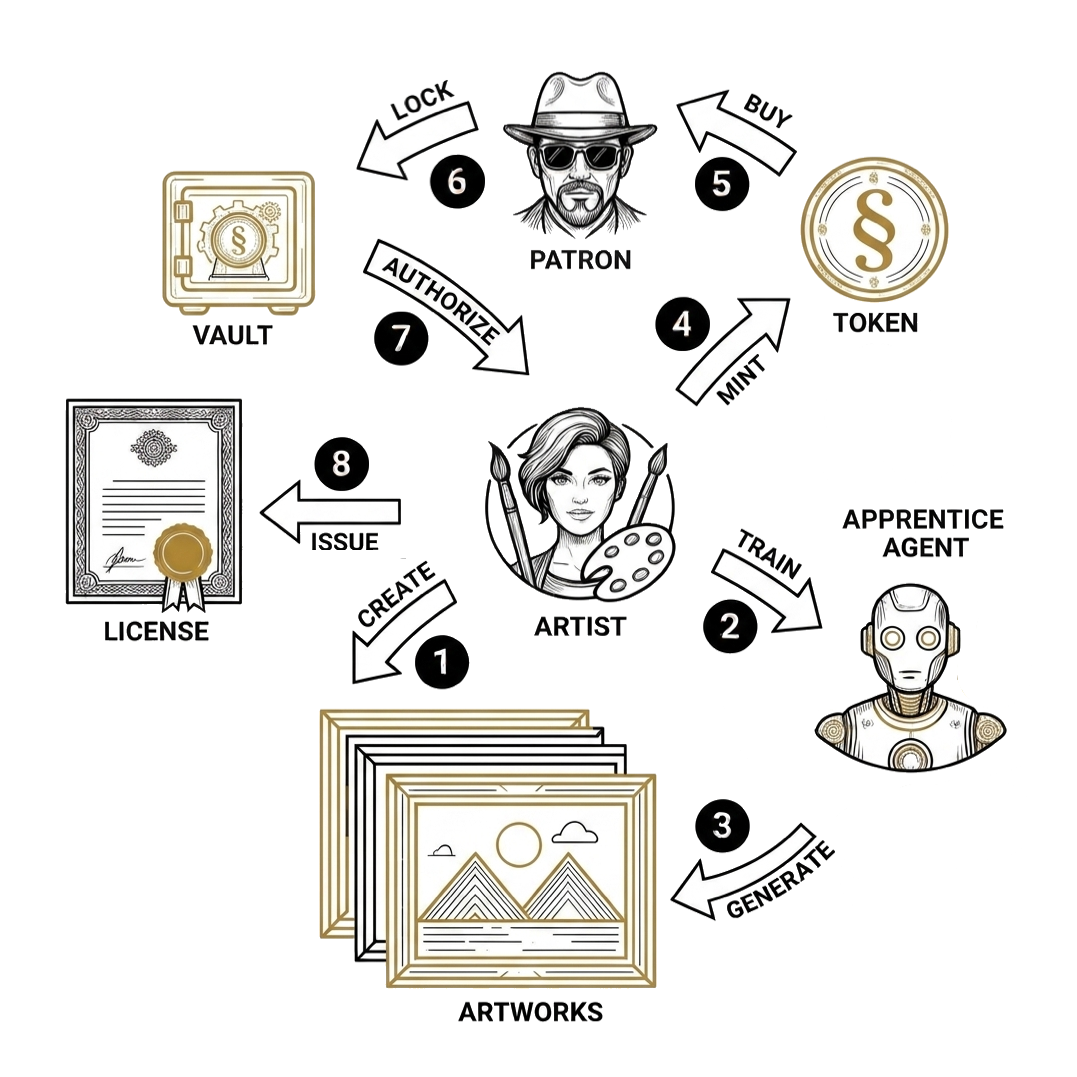
SoulStakes introduces a different model. Every participating artist has an artist token. Patrons acquire and lock those tokens to activate specific, time-bound rights authorized by the artist — displaying works on screens, accessing releases, producing authorized editions, submitting commissions, attending experiences, or generating new images through a model trained exclusively with the artist’s consent.
You teach an AI agent your style — what it may learn from, what it may never do. It answers any prompt with a drawing that is unmistakably yours. And every drawing pays you.
The heart of SoulStakes
Rights exist while the required tokens remain locked. When the tokens are unlocked, continuing rights expire according to the applicable license. SoulStakes separates ownership of an art object from access to an artist’s creative world — and makes that access something artists can define, measure, and be paid for.
The market sells objects. The value is the relationship.
The Problem
1.1The art market primarily monetizes objects
The existing art economy is built around transactions involving discrete works. An artist creates an object; a gallery or marketplace sells it; the buyer receives possession and a limited set of implied privileges. This structure remains valuable, but it is incomplete.
An artist’s economic value also resides in the audience’s continuing relationship with the artist: access to the body of work, the recognizable visual language, future releases, display and reproduction rights, cultural endorsement, commissions, experiences, and — where the artist consents — controlled access to generative models derived from the work. Conventional licensing, memberships, and merchandising monetize fragments of this value, but they remain fragmented, bespoke, and administratively expensive.
1.2Artists are pressured to produce continuously
Most working artists earn only when they produce something new, sell an existing work, accept a commission, license an image, teach, obtain a grant, or exhibit. This creates continual production pressure.
A strong body of work should be capable of supporting a continuing economy of access — without requiring the artist to become a production mill.
Section 1.2
1.3Collectors acquire objects but lack participation
Many collectors want to support artists, not merely acquire inventory. Yet the conventional market gives them blunt instruments: purchase an original, buy an edition, donate, follow the artist online, or speculate. SoulStakes turns collecting into active patronage — a Patron holds and locks a stake that activates a continuing relationship with the artist’s authorized creative ecosystem.
1.4Institutions face rigid acquisition models
Museums, hotels, cultural organizations, corporations, galleries, retailers, publishers, and public venues obtain art through acquisition, rental, commission, exhibition, or conventional licensing — approaches that are often rigid, expensive, and work-specific. SoulStakes lets institutions hold transparent positions in artists and activate defined rights across named locations, screens, exhibitions, editions, events, and campaigns.
1.5AI separates capability from consent
Generative systems can reproduce broad visual characteristics associated with artists. The central objection for many artists is not merely that AI can generate images — it is that their work may be used without informed consent, control over the training dataset, restrictions, attribution, compensation, revocation, or reliable records.
SoulStakes establishes a system in which particular uses can be demonstrated to be authorized. Artists voluntarily approve the source works, the model, the permitted uses, the prohibited categories, the pricing, the attribution, the royalties, and the termination conditions. Artists who decline do not participate.
The SoulStakes Thesis
2.1The art market sells objects; SoulStakes sells access
SoulStakes adds a new economic layer above and around conventional art ownership. These rights are not assumed — they are expressly created and published by the artist:
2.2Rights flow through locks
A Patron obtains the required quantity of an artist’s token and locks it in a rights vault. The lock activates the corresponding license. The right remains active while the tokens remain locked, fees are paid, and the Patron remains compliant. When the Patron unlocks, the right terminates or enters a defined wind-down period.
Tokens used to activate rights are removed from active circulation for the duration of the lock — creating a direct, measurable relationship between demand for access and token scarcity.
2.3Artist-authorized access is the asset
SoulStakes does not claim that the artist is an asset owned by token holders. Token holders do not own the artist, the artist’s labor, identity, copyrights, future production, personal time, or any general entitlement to direct the artist. The protocol distinguishes the artist, the artist’s intellectual property, the artist token, the rights catalog, the active license, and individual works or outputs.
Token holders do not own the artist. They hold a stake in an authorized relationship.
Section 2.3
Tokens, locks, rights, and the machinery beneath them.
Participants
3.1Artists
Artists are the originating rights holders and principal beneficiaries. They may verify identity, authorize a token, configure rights, establish lock requirements and fees, approve or reject AI participation, define attribution and prohibited uses, appoint representatives, and receive revenue. No artist is required to offer every right.
3.2Patrons
A Patron is an individual or entity that acquires, holds, or locks artist tokens — collectors, fans, galleries, museums, hotels, corporations, publishers, brands, filmmakers, game studios, interior designers, public institutions.
3.3Institutions
Institutional accounts support multiple users, named venues, delegated administration, procurement documents, invoicing, tax records, private terms, multi-year agreements, and auditable records.
3.4Curators, galleries, estates, and representatives
Artists may delegate curation, pricing, campaign approval, model review, estate administration, infringement handling, or custom negotiations. Delegation must be explicit, limited, and revocable.
3.5Developers and applications
Third-party applications may integrate discovery, token acquisition, rights activation, display, print fulfillment, generation, licensing checkout, attribution verification, and royalty reporting.
Artist Tokens
4.1Purpose
Each participating artist has a distinct token associated with the artist’s SoulStakes ecosystem. Its principal protocol function is to activate rights through locking. The token is not, by itself, ownership of the artist, ownership of copyrights, a claim on all artist income, a guarantee of appreciation, a guaranteed royalty share, or an unconditional right to services.
4.2Issuance models
- Fixed supply — predictable dilution and simple scarcity.
- Artist-governed capped supply — gradual issuance under disclosed rules.
- Continuous issuance — gradual release at transparent prices, with greater regulatory complexity.
- Platform-assisted distribution — primary sales, grants, verified collectors, exhibitions, contribution programs.
4.3Allocation and artist participation
Allocation may include the artist treasury, public distribution, ecosystem incentives, galleries or estates, collaborators, liquidity, and the protocol treasury. Artist retention allows participation in increased demand and preserves influence. Communications should never promise that tokens appreciate because of the artist’s future efforts — legal characterization depends on code, distribution, promises, marketing, and the surrounding arrangement.
4.4Transferability
Tokens may be freely transferable, limited to verified accounts, restricted by jurisdiction, subject to holding periods, or transferable only through approved venues.
4.5Rights staking is not conventional yield staking
Staking, here, simply means locking tokens to switch a right on. It is not the “staking” of crypto markets — no lending, no yield farming, no promised interest.
Section 4.5
The Rights Catalog
5.1Rights are modular
Each artist maintains a catalog of standardized, configurable license modules. A module specifies the right, required token quantity, lock duration, fees, royalties, permitted and prohibited uses, territory, media, audience limits, commercial status, attribution, transferability, sublicensing, reporting, termination, and dispute terms.
5.2Example rights classes
Personal display
Your art on someone’s own screens, at home, noncommercial.
Venue display
Your art in named hotels, restaurants, offices, or shops.
Authorized print
A set number of physical prints, made under your controls.
Exhibition
Temporary public display with approved promotion.
Commission priority
The right to ask — never an obligation for you to accept.
Your AI agent
Drawings in your style, from your approved model, on your terms.
5.3Token requirements and fees
5.4Rights activation
- The Patron selects a rights module.
- The complete license terms are presented.
- The Patron accepts the terms with a simple, recorded agreement.
- Required tokens are committed to a rights vault.
- Required fees are paid.
- The protocol issues an active rights credential.
- Applications verify the credential before delivering protected content or services.
5.5Rights expiration
Rights may expire through unlocking, term completion, unpaid fees, exceeded limits, breach, withdrawal under stated terms, or termination of the artist relationship. Completed uses and continuing uses are treated differently: a validly produced print does not become unauthorized property merely because the underlying lock later ends; generation access can end while previously licensed outputs retain their granted rights.
5.6Rights credentials
Active rights may be represented by non-transferable credentials containing the Patron, artist, module, activation time, expiration conditions, scope, license version, token quantity, and status — while confidential terms remain private.
Artist Economics
6.1Value must flow to the artist
Token demand alone does not guarantee artist income. SoulStakes therefore ties economics to the exercise of rights. Revenue sources may include primary issuance, activation fees, recurring licenses, per-use charges, print royalties, output fees, campaign licenses, merchandise royalties, exhibition fees, commissions, optional transaction fees, and artist treasury holdings.
6.2Rights-based demand
The strongest token demand should arise from use: restaurants display art, publishers obtain illustrations, collectors display works, brands generate campaign imagery, museums program exhibitions.
6.3Lock scarcity
6.4Royalty distribution
6.5Settlement
Artists may be paid instantly or on a schedule, with held balances, minimum payout thresholds, tax records, refunds, reserves, and payment in multiple currencies. Many small earnings may be grouped into a single payout.
Behind the Scenes
7.1Simple on the surface, careful underneath
What artists and patrons see is simple: a profile, a catalog of rights, a lock, and a dashboard. Underneath, SoulStakes keeps careful records so that every right can be trusted.
- A verified register of artists — identity, representatives, rights catalog, payment destination, and each artist’s AI consent choices.
- A permanent record of every rights module and its terms, so a license can never quietly change after it has been activated.
- Secure vaults that hold locked tokens for exactly as long as a right is active, and release them when it ends.
- A one-step check that lets any approved app, gallery, or venue confirm whether a right is currently active — nothing more.
7.2Privacy
SoulStakes should support public patronage, pseudonymous participation, confidential institutional licenses, hidden fee amounts, selective disclosure, and privacy-preserving verification.
You teach it. It draws like you. You get paid.
Your AI Agent, on Your Terms
8.1The idea
Imagine an agent that has studied only what you chose to teach it — your line, your color, your rhythm. Someone types a prompt, and it answers with a drawing that could only have come from your hand.
You decide what it learns from. You decide what it may never draw. You can pause it or retire it whenever you want. And every drawing it makes pays you. That is the heart of SoulStakes — and it is entirely optional. An artist who wants no part of AI simply never turns it on, and still enjoys everything else the platform offers.
8.2Nothing happens without your yes
Joining SoulStakes, uploading images, or having a token does not mean you have said yes to AI. Each of these needs its own, separate permission: learning from your works, making drawings, personal use, commercial use, spin-off models, downloading the model, combining it with others, keeping prompts, and letting it learn from its own drawings.
8.3The Artist Agent
Your Artist Agent is a private model taught only from works you approved, guided by your own rules — with filters that reject anything prohibited or too close to an existing work, a record of every use, and automatic payment to you.
The artist’s model stays private and under the platform’s care. If it could be downloaded, the artist would lose the ability to meter, restrict, retire, and get paid.
Section 8.3
8.4What the agent learns from
Only what you hand it, with permission recorded for every item: finished works, sketches, studies, process shots, close-up details, your own captions, palette references, and approved photographs.
8.5It learns your style, not your works
The agent studies how you make marks — line weight, texture, rhythm, how your colors relate, how you fill space, how you light a scene. It is taught to absorb your style without copying your works, your characters, your motifs, or your signature.
8.6Artist controls
| Model characteristic | Status |
|---|---|
| General line and mark-making | Permitted |
| Color relationships | Permitted |
| Material texture | Permitted |
| Compositional tendencies | Permitted |
| Signature motif | Restricted |
| Named character series | Prohibited |
| Existing work recreation | Prohibited |
| Artist signature | Prohibited |
| Political content | Prohibited |
| Commercial advertising | Approval required |
8.7Model training and approval
- The dataset is curated and every item’s rights are verified.
- Works are captioned and structurally annotated.
- Several candidate models are trained.
- Standardized evaluations run on familiar and unfamiliar subjects.
- Memorization and similarity analysis is performed.
- The artist reviews the model, and it is revised as requested.
- The artist-approved model version is registered.
8.8Model versions
Every approved model has a version number, a record of exactly what it was trained on, its evaluation results, the artist’s written approval, the rules it must follow, and its current status.
8.9How a drawing is made
8.10Preview and final outputs
Preview
Small, inexpensive, noncommercial — for exploring an idea.
Final personal
Full quality for personal use, with a certificate and your royalty.
Commercial
A defined campaign, territory, audience, and price.
Artist-reviewed
Generated, then selected, refined, or finished by your own hand.
8.11Generation pricing
| Event | Charge |
|---|---|
| Preview generation | $0.25 |
| Final personal output | $12 |
| Small-business license | $75 |
| Regional campaign | $500 |
| National campaign | $1,500+ |
| Product packaging | $2,500+ |
| Merchandise | Minimum + royalty |
| Artist review or finishing | Artist-defined |
8.12Similarity and memorization controls
Every output is automatically compared against the artist’s existing works, with prompt restrictions, human review where needed, and thresholds the artist sets. Requests to recreate named works, counterfeit editions, reproduce signatures, or make trivial substitutes are prohibited.
8.13Human participation and copyright
Authorization does not guarantee that every output receives copyright protection. SoulStakes distinguishes authorized outputs, artist-endorsed outputs, human-authored composites, and works that may qualify for registration. The protocol can establish authorization and provenance; it cannot determine copyrightability in every jurisdiction.
8.14Training authorization and broader copyright law
SoulStakes relies on affirmative permission for artist-specific training rather than solely on contested theories of implied permission or fair use. Consent materially strengthens the authorization chain without resolving every possible legal question.
8.15International transparency
Model registries, documentation, copyright policies, training-content summaries, and labeling should meet or exceed applicable transparency obligations, including emerging European requirements.
Provenance and the Authorized Output Manifest
9.1Every final output receives a record
Every accepted image carries a permanent certificate — like a gallery’s certificate of authenticity, written automatically at the moment of creation.
- The artist
- Verified, and consented
- The model
- Approved by the artist — version 3.1
- The license
- Commercial campaign
- The patron
- Held an active right
- Created
- July 14, 2026
- Artist paid
- $7.50, at the moment of creation
- Verifiable
- By anyone, forever
9.2Content Credentials
Each image also carries Content Credentials — the same open labeling standard used by major camera makers and creative tools. The label says the image was generated, names the artist-authorized model and license, and points back to the SoulStakes record.
9.3Provenance is not proof of truth
A certificate proves that someone stood behind a claim. That is why SoulStakes verifies every artist at onboarding, guards the ability to issue certificates, keeps auditable records, and maintains clear procedures for revocation and disputes.
9.4Durable discovery
Labels can be stripped from an image. SoulStakes therefore keeps its own permanent record of every authorized output, so an image can be matched back to its certificate even after its label is removed.
9.5Public verification
Registration, artist authorization, model version, signature validity, license authenticity, and revocation or dispute status are all publicly verifiable — by anyone, without exposing private commercial terms.
Control, governance, law, and the lines that don't move.
Artist Control and Revocation
10.1Artist autonomy
Artists may stop offering modules, modify future pricing and prohibitions, suspend generation, retire versions, approve replacements, change representatives, and leave under the governing agreement.
10.2Existing rights
Withdrawal rules must protect validly issued licenses. Existing fixed-term rights may continue, enter wind-down, receive refunds, or terminate only for defined causes.
10.3Model retirement
Retired models stop generating new outputs; past records remain verifiable; completed-output licenses continue under their original terms.
10.4Emergency suspension
Compromised keys, unauthorized datasets, impersonation, court orders, critical failures, and systemic prohibited output may justify narrow, logged, reviewable suspension.
Governance
11.1Layered governance
Artist authority controls artist-specific rights, IP, models, pricing, and treasury. Protocol governance controls standards, contracts, technical upgrades, shared fees, security, and grants. Independent review handles disputes and appeals.
11.2Artist-specific governance
Artists may involve Patrons in exhibition choices, rotations, archival projects, publications, or community initiatives.
Token holders do not automatically control creative decisions.
Section 11.2
11.3Protocol safeguards
Governance should include timelocks, public proposals, audits, emergency procedures, conflict disclosures, quorum rules, and separation of commercial management from dispute review.
Legal and Compliance Design
12.1Rights exist through contracts
The platform’s records provide evidence and enforcement; legally operative agreements define the actual intellectual-property license.
Chain of title
Onboarding reviews galleries, publishers, co-creators, estates, and prior agreements — so every right offered is truly the artist’s to offer.
Moral rights
Artists control naming, anonymity, modification, political association, and the company their work keeps.
Financial regulation
Tokens are designed and described carefully, without promises of profit or appreciation, respecting each jurisdiction.
Patron protection
Patrons see plainly what they are buying, what they are not, and every condition, fee, and risk.
Identity checks
Larger transactions may require identity verification and the financial safeguards the law expects.
Data protection
Identity records, art files, prompts, and payments are guarded, retained only as needed, and deletable.
Safety and Misuse
13.1Artist-defined prohibitions
Artists may prohibit, among other things:
13.2Platform-level prohibitions
Baseline restrictions include illegal material, child sexual abuse material, nonconsensual intimate imagery, fraud, counterfeit certificates, unauthorized reproduction, identity deception, and rights evasion.
13.3Licensee responsibility
Licensees remain responsible for references, trademarks, depicted persons, publicity rights, advertising claims, local law, and uses beyond the license.
13.4Enforcement
Remedies may include rejection, suspension, revocation, denial of generation, takedowns, contractual damages, and referral to authorities.
A minimum viable protocol, then a widening circle.
Business Model
14.1Protocol revenue
Revenue may come from activation fees, marketplace fees, a margin on generation, commercial licensing, institutional subscriptions, print fulfillment, certification services, model training, and services for partner apps.
14.2Artist onboarding
Onboarding may be platform-funded, artist-paid, grant-supported, gallery-sponsored, institution-sponsored, or structured as a recoverable advance. Artists should not face excessive upfront costs before demand is proven.
14.3Institutional services
Institutions may pay for portfolio access, venue management, screen orchestration, compliance records, curation, custom licensing, and centralized billing.
14.4Developer economy
Third-party applications may earn disclosed fees for discovery, curation, display, generation, production, licensing, and verification — without bypassing artist royalties.
Initial Product
15.1Minimum viable protocol
The initial release should include verified onboarding, one token per artist, fixed modules, token locking, active-right credentials, personal and venue display, dashboards, a one-step rights check for venues and apps, royalty accounting, and provenance records.
15.2Initial AI implementation
The initial AI implementation covers three to five consenting artists, carefully curated training material, one private model per artist, artist approval, personal and commercial tiers, metered use, similarity controls, certificates on every output, royalty allocation, and the ability to suspend everything.
15.3What stays protected
Full-resolution artwork, model files, training material, prompts, invoices, and sensitive licenses are never published openly — they remain on protected systems.
Roadmap
Success Metrics
SoulStakes should prioritize verified artists, active Patrons, locked token share, active rights, artist revenue, revenue per artist, renewals, utilization, commercial volume, institutional retention, authorized outputs, artist share of revenue, disputes, rejection rates, and provenance verification.
The common thread: what matters is use and artist income, not price.
Risks, differences, and the question answered.
Risks
A protocol that will not name its risks should not be trusted with an artist’s life’s work. These are the ten risks SoulStakes tracks.
Regulation
Artist tokens may be treated differently in different countries.
Speculation
Trading could drown out real use; the product must stay use-first.
Thin artist revenue
Demand could reward holders more than artists without careful design.
Agent quality
A weak agent embarrasses its artist; approval and suspension are mandatory.
Memorization
Drawings too close to real works; similarity checks reduce the risk.
Extraction
Attackers may try to copy a model through endless prompts; limits and monitoring push back.
Stripped labels
Certificates can be peeled off an image; the permanent record survives.
Confusion
Owning a token, holding a right, and owning art are different things — the interface must keep them distinct.
Departure & death
Withdrawal, incapacity, estates, and successors all need clear procedures.
Platform capture
Open standards and portable records keep SoulStakes from becoming the next extractive middleman.
Why SoulStakes Is Different
SoulStakes is not an NFT marketplace, a fractional ownership platform, a fan token with vague benefits, an AI-style marketplace, a conventional subscription, an image generator, or a purely speculative artist market.
It combines artist-specific tokens, rights activated through locks, explicit licensing, continuing artist compensation, public patronage, institutional access, artist-authorized AI, permanent certificates of authorization, and verification anyone can use.
The unit being exchanged is not simply an image. It is a continuing, artist-authorized relationship.
Section 19
The AI Question, Resolved
Artificial intelligence does not require the elimination of artists from the economic chain. It does not require that an artist’s work be treated as an unowned natural resource. It does not require that every artist participate.
Artists who opt in approve the works used for training, the model, the permitted outputs, personal or commercial use, autonomous or reviewed workflows, pricing, and royalties. Patrons lock tokens to obtain access. Every accepted final output is registered and carries signed provenance linking it to the artist-authorized model and applicable license. Every paid use allocates compensation to the artist. Artists who refuse AI participation retain that choice.
For an authorized SoulStakes output, each of these questions has a clear answer:
- Was the artist asked?
- Did the artist consent?
- Which works were approved?
- Which model was approved?
- What uses are permitted?
- Who generated the output?
- Is the output registered?
- Was the artist paid?
- Can the authorization be verified?
The Primitive
The traditional art market organizes value around objects. SoulStakes organizes value around access.
Artists define what may be accessed. Patrons demonstrate commitment by holding and locking artist tokens. Institutions establish visible, durable relationships with artists. Applications verify rights through a common protocol. Artificial intelligence becomes a consensual licensing channel rather than an extraction mechanism.
Artist-authorized access is an asset class.